Wednesday, May 4, 2016

Gulab Jambu Information
Gulab Jambu Information

Gulaab Jamun (homemade!) bright.jpg

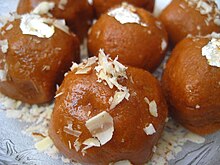
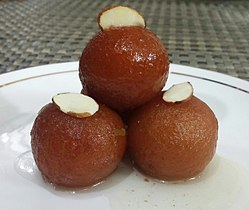
Gulab jamun topped with almond slivers


Gulab jamun, or gulaab jamun, is a milk-solids-based sweet mithai, popular in countries of South Asia and found in such as Indian cuisine, Sri Lankan cuisine, Nepalese cuisine (known as Lal Mohan), Pakistani cuisine and Bangladeshi cuisine. It is also common in Mauritius and the Caribbean countries of Trinidad and Tobago, Guyana, Suriname and Jamaica. In Nepal, it is widely known as lal mohan. It is made mainly from milk solids, traditionally from freshly curdled milk. It is often garnished with dried nuts like almonds to enhance flavour according to Middle Eastern tradition.

Preparation
In India, milk solids are prepared by heating milk over a low flame for a long time until most of the water content has evaporated. These milk solids, known as khoya in India and Pakistan, are kneaded into a dough, sometimes with a pinch of flour, and then shaped into small balls and deep-fried at a low temperature of about 148 °C. The balls are then soaked in a light sugary syrup flavored with green cardamom and rose water, kewra or saffron. Gulab jamun and is available commercially, at South Asian restaurants or pre-prepared either in tins or as kits to be prepared at home.

Origins
Gulab jamun was first prepared in medieval India, derived from a fritter that Persian-speaking invaders brought to India. One theory claims that it was accidentally prepared by the Mughal emperor Shah Jahan's personal chef.

The word "gulab" is derived from the Persian words gol (flower) and āb (water), referring to the rose water-scented syrup. "Jamun" or "jaman" is the Hindi-Urdu word for Syzygium jambolanum, an Indian fruit with a similar size and shape. The Arab dessert luqmat al-qadi is similar to gulab jamun, although it uses a completely different batter. According to the culinary historian Michael Krondl, both luqmat al-qadi and gulab jamun may have derived from a Persian dish, with rose water syrup being a common connection between the two.


Consumption customs
Gulab jamun is a dessert often eaten at festivals, birthdays or major celebrations such as marriages, the Muslim celebrations of Eid ul-Fitr and Eid al-Adha, and the Hindu festival of Diwali (the Indian festival of light). There are various types of gulab jamun and every variety has a distinct taste and appearance.


Pantua

Type Confectionery
Place of origin India
Region or state Bengal

Main ingredients Semolina, khoya, milk, ghee and sugar

Pantua (Bengali: পান্তুয়া) is a local confection of eastern India and Bangladesh. It is a traditional Bengali sweet made of deep-fried balls of semolina, chhana, milk, ghee and sugar syrup. Pantuas range in colour from pale brown to nearly black depending on how long they are fried. Rose water, cardamom or other flavourings are sometimes added to the sweet.

Pantua is very similar to the cheese-based fried sweet ledikeni. The distinctive feature of ledikeni is its molten sugar syrup of lightly flavored cardamom powder.[1] The name ledikeni is a rendition of "Lady Canning" and was first used by confectioner Bhim Chandra Nag, when he renamed his pantuas specially prepared on the occasion of the birthday of Countess Charlotte Canning, wife of Governor-General Charles Canning.


Pantua is similar to gulab jamun, and could be called a Bengali variant of that dish.


Ledikeni

Ledikeni (Bengali: লেডিকেনি) or Lady Kenny is a popular sweetmeat of West Bengal. It is a light fried reddish-brown sweet ball made of chhana and flour and filled with molten sugar syrup. Ledikeni is named after Lady Canning, the wife of Charles Canning, the Governor-General of India during 1856-62.

History
The sweet originated in Kolkata in the middle of the 19th century. There are various legends regarding the origin of the sweet. According to the most popular legend, a special sweetmeat was prepared by Bhim Chandra Nag in the honour of Lady Canning at some point during her stay in India from 1856 till her death in 1861. In some versions of the tale, the sweetmeat was prepared to commemorate her visit to India in 1856, while in other versions, it was prepared on the occasion of her birthday.Some variations of the tale state that it became her favourite dessert, which she would demand on every occasion. According to yet another legend, the sweet was prepared by the confectioners of Baharampur in 1857, after the mutiny, to commemorate the visit by Canning and his wife.


Lady Canning died in 1861. Since then the sweetmeat has gained immense popularity in Bengal. No grand feast was considered complete if the sweetmeat was not offered to the guest. The manufacturer was said to have made a lot of money by selling the sweetmeat. As it gained popularity, the sweetmeat came to be known as "Lady Canning" which gradually got corrupted to "ledikeni".


Monday, April 11, 2016

Information about Laddu / Laddoo

Laddu

Laddu or laddoo are ball-shaped sweets popular in the Indian Subcontinent. Laddus are made of flour, minced dough and sugar with other ingredients that vary by recipe. They are often served at festive or religious occasions

Laddu
Coconut and Jaggery Balls ......


Place of origin South Asia
Coconut and Jaggery Balls ...... Bengali Narkel Naru.jpg
Coconut and Jaggery Balls

Main ingredients Flour, milk, sugar

Variations Gram flour, rava

Other information Served on festive or religious occasions


Laddus packed for a wedding


Laddus
Laddu or laddoo are ball-shaped sweets popular in the Indian Subcontinent. Laddus are made of flour, minced dough and sugar with other ingredients that vary by recipe. They are often served at festive or religious occasions.

Composition
Common flours used for laddu include besan (chickpea flour), rava (wheat semolina) and ground coconut. These are combined with sugar and other flavorings, cooked in ghee and molded into a ball shape. Some laddu recipes are prepared using Ayurvedic medicinal ingredients, including methi laddu, multigrain and resin laddu. Nuts such as pistachios and almonds are commonly stuffed into laddus.

Boondi laddu
Boondi laddu is made from boondi. It is often served in occasions like marriages, or festivals such as Raksha bandhan and Diwali. Motichoor laddu is made from fine boondi where the balls are tiny and is cooked with ghee or oil. Originally this laddu was a north indian sweet, but it is now popular throughout India.

Besan laddu
Besan laddu (Hindi: बेसन के लड्डू) is a popular Indian sweet dish made of Besan (chickpea flour or gram flour), sugar and ghee.


Besan Laddu decorated with silver foil and almond chips.
Besan is roasted in ghee till golden brown appearance with nutty fragrance. Then sugar is added to it. Pistachio pieces are also mixed in this mixture optionally. Sweet balls are then made from this mixture. It has a long shelf life.

It is often served at festivals, family events and religious occasions in India.

Coconut laddoo
There are multiple coconut laddu recipes. Its earliest form Narayl Nakru dates back to the time of the Chola Empire, when it was a sweet that was packed for travelers and warriors as a symbol of good luck for their expeditions.

Laddu with edible gum
This laddu is popular in the Indian state of Maharashtra. It is called Dinkache ladoo in the Marathi. They are traditionally given to lactating mothers as they help in the production of milk. The main ingredient in the recipe is Gum arabic which is collected from the Babhul tree. Other ingredients include coconut, Almonds, Cashews, dates, spices such as Nutmeg and Cardamom, Poppy seeds, Ghee, and Sugar. An alternative multigrain recipe will have a portion of gum replaced by grains and legume flours such as besan, urid, ragi(nachani in Marathi) and wheat

Use
Laddu is often prepared for festivals or family events such as weddings and births, or given as a prasad at Hindu temples, especially at Venkateswara Temple, Tirumala, Andhra Pradesh, it is famous with the name Tirupati Laddu.

In Maharashtrian cuisine, there are traditional recipes for laddu intended as travel provisions.

Cultural references
In the Sesame Street episode "Rakhi Road", laddus are featured prominently as a favoured Indian dessert. Elmo is shown making laddus and enjoying eating them as part of the celebrations around the Indian festival of Rakhi.

A laddu weighing 6,300 kg was made for a Ganesh festival in Andhra Pradesh, India in September 2012. This was claimed to be the largest known laddu.

In the movie English Vinglish, the protagonist Shashi Godbole (Sridevi) is a housewife who makes and sells laddoos as a home-run business.

Saturday, March 12, 2016

Masala Tea Chai Information


Masala chai (/tʃaɪ/; Hindi: मसाला चाय, literally "mixed-spice tea"; Urdu: مصالحہ چائے‎; Nepali: मसलेदार चिया; Bengali: মসলা চা; Gujarati: મસાલા ચા) is a flavoured tea beverage made by brewing black tea with a mixture of aromatic Indian spices and herbs. Originating in India,[1][2][3] the beverage has gained worldwide popularity, becoming a feature in many coffee and tea houses. Although traditionally prepared by a decoction of green cardamom pods, cinnamon sticks, ground cloves, ground ginger, and black peppercorn together with black tea leaves, retail versions include tea bags for infusion, instant powdered mixtures, and concentrates. In some places the term "chai" alone can refer to the beverage.


Contents  [hide]
1 Etymology and terminology
2 Traditional masala chai
2.1 History
3 Ingredients
3.1 Tea
3.2 Spices
3.3 Milk
3.4 Sweetener
3.5 Preparation
4 Outside South Asia
4.1 Tea-based mixes and concentrates
4.2 In Western cultures
4.3 Cold "chai"
4.4 Components
5 See also
6 References
7 External links
Etymology and terminology[edit]

Unlike many milky teas, which are brewed in water with milk later added, traditional masala chai is often brewed directly in the milk.[citation needed]
Main article: Etymology of tea
In many Eurasian languages, chai or cha is the word for tea. This comes from the Persian چای chay, which originated from the Chinese word for tea 茶 chá. (The English word tea, on the other hand, comes from the Teochew dialect of Chinese teeh.) In English, this spiced tea is commonly referred to as masala chai or simply chai,[4] even though the term refers to tea in general in the origin language. Numerous United States coffee houses use the term chai latte or chai tea latte for their version to indicate that the steamed milk, much like a regular cafè latte, is mixed with a spiced tea concentrate instead of espresso. By 1994 the term had gained currency on the U.S. coffeehouse scene.[5]
In the Middle East, particularly in the Arab countries surrounding the Persian Gulf where it is highly popular, the drink is commonly called "karak chai" (lit. strong tea) by the locals.
Traditional masala chai[edit]

Spices used for Masala chai
History[edit]
See also: Indian tea culture and Pakistani tea culture
Tea plants have grown wild in the Assam region since antiquity, but historically Indians viewed tea as a herbal medicine rather than as a recreational beverage.[6] Some of the chai masala spice mixtures, or Karha,[7] that are still in current use are derived from Ayurvedic medical texts.
In the 1830s, the British East India Company became concerned about the Chinese monopoly on tea, which constituted most of its trade and supported the enormous consumption of tea in Great Britain: approximately one pound (by weight) per person per year. British colonists had recently noticed the existence of the Assamese tea plants, and began to cultivate tea plantations locally. In 1870, over 90% of the tea consumed in Great Britain was still of Chinese origin, but by 1900 this had dropped to 10%, largely replaced by tea grown in British India (50%) and British Ceylon (33%).
However, consumption of black tea within India remained low until the promotional campaign by the (British-owned) Indian Tea Association in the early 20th century, which encouraged factories, mines, and textile mills to provide tea breaks for their workers. It also supported many independent chai wallahs throughout the growing railway system.
The official promotion of tea was as served in the English mode, with small added amounts of milk and sugar. The Indian Tea Association initially disapproved of independent vendors' tendency to add spices and greatly increase the proportions of milk and sugar, thus reducing their usage (and thus purchase) of tea leaves per liquid volume. However, masala chai in its present form has now firmly established itself as a popular beverage.[8]
Ingredients[edit]

A man in Kolkata, India with a tray for serving nine glasses of chai
There is no fixed recipe or preparation method for masala chai and many families have their own versions of the tea. Most chai contains caffeine typically 1/3 that of coffee (if made with a black tea base). The tea leaves steep in the hot water long enough to extract intense flavour, ideally without releasing the bitter tannins. Because of the large range of possible variations, masala chai can be considered a class of tea rather than a specific kind. However, all masala chai has four basic components: milk, sugar, cardamom, and ginger
Tea[edit]
The base tea is usually a strong black tea such as Assam, so that the spices and sweeteners do not overpower it. Usually, a specific type of Assam is used called "mamri". Mamri tea is tea that has been cured in a special way that creates granules as opposed to "leaf" tea. It is inexpensive and the tea most often used in India. However, a wide variety of teas are used to make chai. Most chai in India is brewed with strong black tea, but Kashmiri chai is brewed with gunpowder tea.
Spices[edit]

Spices and cut tea leaves
The traditional masala chai is a spiced beverage brewed with different proportions of warming spices. The spice mixture, called Karha, uses a base of ground ginger and green cardamom pods. Other spices are usually added to this base or karha. For example, most masala chai found on the street, in restaurants or in homes incorporates one or more of the following along with ginger and cardamom, namely: cinnamon, star anise, fennel seeds, peppercorn, nutmeg and cloves. In the Western world, using allspice, to either replace or complement the cinnamon and clove, is also common.
Traditionally, cardamom is a dominant note, supplemented by other spices such as cloves, ginger, or black pepper; the latter two add a heat to the flavour. The traditional composition of spices often differs by climate and region in Southern and Southwestern Asia.
For example, in Western India, cloves and black pepper are expressly avoided.[citation needed] The Kashmiri version of chai is brewed with green tea instead of black tea and has a more subtle blend of flavourings: almonds, cardamom, cinnamon, cloves, and sometimes saffron. In Bhopal, typically, a pinch of salt is added.
Other possible ingredients include nutmeg, mace, black cardamom, chilli, coriander, rose flavouring (where rose petals are boiled along with the loose-leaf tea), or liquorice root. A small amount of cumin, is also preferred by some people. A small amount of turmeric may be added to aid those suffering from a fever.
Milk[edit]
Main article: milk
Traditionally in India, buffalo milk is used to make chai.[9] In the United States, whole cow milk is usually used for its richness. Generally, masala chai is made by mixing ¼ to ½ parts milk with water and heating the liquid to near-boiling (or even full boiling). As noted above, some people like to use condensed milk in their masala chai to double as the sweetener. For those who prefer to drink chai without milk, the portion is replaced with water.
Sweetener[edit]
Main article: sweetener
Plain white sugar, Demerara sugar, other brown sugars, palm or coconut sugars, syrup, or honey is used. Jaggery is also used as a sweetener, mostly in rural parts of India. While some prefer unsweetened chai, some sugar enhances the flavour of the spices.
Some recipes use up to three tablespoons of sugar in 3½ cups of chai. Condensed milk can also be added as a dual-purpose sweetener and dairy addition. Sugar is typically added to suit the drinker.
Preparation[edit]

A boy in Mysore, India preparing masala chai. As chai is prepared by decoction, preparation usually includes straining tea from the solids.
The simplest traditional method of preparing masala chai is through decoction, by actively simmering or boiling a mixture of milk and water with loose leaf tea, sweeteners, and whole spices. Indian markets all over the world sell various brands of "chai masala", (Hindi चाय मसाला [chāy masālā], "tea spice") for this purpose, though many households or tea vendors, known in India as "chai wallahs",[10] blend their own. The solid tea and spice residues are strained off from masala chai before serving.
The method may vary according to taste or local custom: for example, some households may combine all of the ingredients together at the start, bring the mixture to a boil, then immediately strain and serve; others may leave the mixture simmering for a longer amount of time, or begin by bringing the tea leaves to a boil and only add the spices toward the end (or vice versa).
A common Maharashtrian practice for preparation of one cup of chai is to first combine one half cup of water with one half cup of milk in a pot over heat. Sugar may be added at this point or after. Ginger is then grated into the mixture followed by adding a "tea masala". Although the ingredients may vary from region to region, "tea masala" typically consists of cardamom powder, cinnamon powder, ground cloves, ginger powder, and pepper powder. The mixture is brought to a boil and 1 teaspoon of loose black tea is added. The chai is immediately taken off the heat, covered, and allowed to sit for approximately 10 minutes to allow the black tea to infuse into the chai. The chai is then strained and served.
Outside South Asia[edit]

A soy vanilla chai latte served in Berlin
As the popularity of masala chai has spread around the world, its nature has changed in various ways beyond the somewhat redundant terminology noted above.
Chai flavouring is also used in baked goods such as pumpkin pies, biscuits or butter tarts.
Masala chai is popular in East Africa, particularly on the coast.[11][12]
Tea-based mixes and concentrates[edit]
Liquid "chai concentrates" have become very popular for their convenience, as these spiced, sweetened tea-based syrups merely require dilution with milk, water, or both to create a flavourful hot or cold beverage. Most American coffeehouse chains use commercial liquid concentrates instead of brewing their own chai from scratch. Dry powdered or granular mixes similar to instant coffee are also commercially available.
Both dry instant mixes and liquid concentrates can be replicated at home. A liquid concentrate can be made by brewing an unusually concentrated pot of highly spiced tea, so that the dilution of a small amount into a cup of hot water or a glass of cold milk results in roughly the same concentration of tea as in a normally proportioned brew; e.g., to make a syrup from which one ounce suffices to make one eight-ounce cup of normal chai when diluted, brew tea (and the proportional quantity of spices) at eight times normal concentration.
Similarly, unsweetened iced-tea powder can be tailored to individual taste with powdered spices, sugar, and (if desired for convenience and texture) dry nonfat milk and dry non-dairy creamer; the result can be mixed with hot water to produce a form of instant chai masala. This form of dry mix has certain disadvantages, however: the powdered spices may leave a grainy residue at the bottom of the cup, and it may dissolve poorly in cold water, especially in the presence of dry milk/creamer powders.
In Western cultures[edit]
Many western supermarkets offer teabags of chai which contain an assortment of ground chai spices and require steeping in hot water.
Some American supermarkets also carry bottles of "chai spice" alongside their dried herbs and other spices. Unlike Indian spice mixtures, the American ones are generally made from powdered spices (cassia tends to be the dominant flavour) and sometimes sugar; this mixture can be added at the last minute to an already-brewed cup of tea as there is no need to strain off the solids.
Cold "chai"[edit]
As an alternative to the hot tea format, several types of cold "chai" beverages have become popular in the United States. These range in complexity from a simple spiced iced tea without milk to a slush of spiced tea, ice, and milk (or non-dairy creamer) mixed in a blender and topped with whipped cream.[13]
Components[edit]
Many Western commercial preparations use non-traditional ingredients such as vanilla or chocolate, relegating the traditional masala spices to a relatively minor role.
Non-tea-based variants may be prepared with herbal teas or with the South American beverage yerba mate.
Some coffeehouses in the United States offer a version of masala chai augmented with espresso, but this beverage does not have any one universally recognised name. Depending on the establishment, it may be called "java chai", "red eye chai", "chai charger", "tough guy chai", "dirty chai", or many other different names.[citation needed] However, despite the common use in many localities to use the term "latte" as an abbreviation of "caffe latte" ("cafe latte"), the term "chai latte" does not generally imply the presence of coffee in the beverage; see the Spiced tea terminology above (literally, "latte" is Italian for "milk").