Gulab Jambu Information
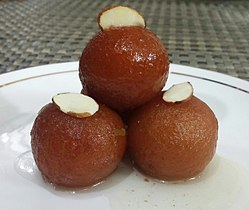
Gulab jamun topped with almond slivers
Gulab jamun, or gulaab jamun, is a milk-solids-based sweet mithai, popular in countries of South Asia and found in such as Indian cuisine, Sri Lankan cuisine, Nepalese cuisine (known as Lal Mohan), Pakistani cuisine and Bangladeshi cuisine. It is also common in Mauritius and the Caribbean countries of Trinidad and Tobago, Guyana, Suriname and Jamaica. In Nepal, it is widely known as lal mohan. It is made mainly from milk solids, traditionally from freshly curdled milk. It is often garnished with dried nuts like almonds to enhance flavour according to Middle Eastern tradition.
Preparation
In India, milk solids are prepared by heating milk over a low flame for a long time until most of the water content has evaporated. These milk solids, known as khoya in India and Pakistan, are kneaded into a dough, sometimes with a pinch of flour, and then shaped into small balls and deep-fried at a low temperature of about 148 °C. The balls are then soaked in a light sugary syrup flavored with green cardamom and rose water, kewra or saffron. Gulab jamun and is available commercially, at South Asian restaurants or pre-prepared either in tins or as kits to be prepared at home.
Origins
Gulab jamun was first prepared in medieval India, derived from a fritter that Persian-speaking invaders brought to India. One theory claims that it was accidentally prepared by the Mughal emperor Shah Jahan's personal chef.
The word "gulab" is derived from the Persian words gol (flower) and āb (water), referring to the rose water-scented syrup. "Jamun" or "jaman" is the Hindi-Urdu word for Syzygium jambolanum, an Indian fruit with a similar size and shape. The Arab dessert luqmat al-qadi is similar to gulab jamun, although it uses a completely different batter. According to the culinary historian Michael Krondl, both luqmat al-qadi and gulab jamun may have derived from a Persian dish, with rose water syrup being a common connection between the two.

Consumption customs
Gulab jamun is a dessert often eaten at festivals, birthdays or major celebrations such as marriages, the Muslim celebrations of Eid ul-Fitr and Eid al-Adha, and the Hindu festival of Diwali (the Indian festival of light). There are various types of gulab jamun and every variety has a distinct taste and appearance.
Pantua
Type Confectionery
Place of origin India
Region or state Bengal
Main ingredients Semolina, khoya, milk, ghee and sugar
Pantua (Bengali: পান্তুয়া) is a local confection of eastern India and Bangladesh. It is a traditional Bengali sweet made of deep-fried balls of semolina, chhana, milk, ghee and sugar syrup. Pantuas range in colour from pale brown to nearly black depending on how long they are fried. Rose water, cardamom or other flavourings are sometimes added to the sweet.
Pantua is very similar to the cheese-based fried sweet ledikeni. The distinctive feature of ledikeni is its molten sugar syrup of lightly flavored cardamom powder.[1] The name ledikeni is a rendition of "Lady Canning" and was first used by confectioner Bhim Chandra Nag, when he renamed his pantuas specially prepared on the occasion of the birthday of Countess Charlotte Canning, wife of Governor-General Charles Canning.
Pantua is similar to gulab jamun, and could be called a Bengali variant of that dish.
Ledikeni
Ledikeni (Bengali: লেডিকেনি) or Lady Kenny is a popular sweetmeat of West Bengal. It is a light fried reddish-brown sweet ball made of chhana and flour and filled with molten sugar syrup. Ledikeni is named after Lady Canning, the wife of Charles Canning, the Governor-General of India during 1856-62.
History
The sweet originated in Kolkata in the middle of the 19th century. There are various legends regarding the origin of the sweet. According to the most popular legend, a special sweetmeat was prepared by Bhim Chandra Nag in the honour of Lady Canning at some point during her stay in India from 1856 till her death in 1861. In some versions of the tale, the sweetmeat was prepared to commemorate her visit to India in 1856, while in other versions, it was prepared on the occasion of her birthday.Some variations of the tale state that it became her favourite dessert, which she would demand on every occasion. According to yet another legend, the sweet was prepared by the confectioners of Baharampur in 1857, after the mutiny, to commemorate the visit by Canning and his wife.
Lady Canning died in 1861. Since then the sweetmeat has gained immense popularity in Bengal. No grand feast was considered complete if the sweetmeat was not offered to the guest. The manufacturer was said to have made a lot of money by selling the sweetmeat. As it gained popularity, the sweetmeat came to be known as "Lady Canning" which gradually got corrupted to "ledikeni".
Gulab jamun topped with almond slivers
Gulab jamun, or gulaab jamun, is a milk-solids-based sweet mithai, popular in countries of South Asia and found in such as Indian cuisine, Sri Lankan cuisine, Nepalese cuisine (known as Lal Mohan), Pakistani cuisine and Bangladeshi cuisine. It is also common in Mauritius and the Caribbean countries of Trinidad and Tobago, Guyana, Suriname and Jamaica. In Nepal, it is widely known as lal mohan. It is made mainly from milk solids, traditionally from freshly curdled milk. It is often garnished with dried nuts like almonds to enhance flavour according to Middle Eastern tradition.
Preparation
In India, milk solids are prepared by heating milk over a low flame for a long time until most of the water content has evaporated. These milk solids, known as khoya in India and Pakistan, are kneaded into a dough, sometimes with a pinch of flour, and then shaped into small balls and deep-fried at a low temperature of about 148 °C. The balls are then soaked in a light sugary syrup flavored with green cardamom and rose water, kewra or saffron. Gulab jamun and is available commercially, at South Asian restaurants or pre-prepared either in tins or as kits to be prepared at home.
Origins
Gulab jamun was first prepared in medieval India, derived from a fritter that Persian-speaking invaders brought to India. One theory claims that it was accidentally prepared by the Mughal emperor Shah Jahan's personal chef.
The word "gulab" is derived from the Persian words gol (flower) and āb (water), referring to the rose water-scented syrup. "Jamun" or "jaman" is the Hindi-Urdu word for Syzygium jambolanum, an Indian fruit with a similar size and shape. The Arab dessert luqmat al-qadi is similar to gulab jamun, although it uses a completely different batter. According to the culinary historian Michael Krondl, both luqmat al-qadi and gulab jamun may have derived from a Persian dish, with rose water syrup being a common connection between the two.
Consumption customs
Gulab jamun is a dessert often eaten at festivals, birthdays or major celebrations such as marriages, the Muslim celebrations of Eid ul-Fitr and Eid al-Adha, and the Hindu festival of Diwali (the Indian festival of light). There are various types of gulab jamun and every variety has a distinct taste and appearance.
Pantua
Type Confectionery
Place of origin India
Region or state Bengal
Main ingredients Semolina, khoya, milk, ghee and sugar
Pantua (Bengali: পান্তুয়া) is a local confection of eastern India and Bangladesh. It is a traditional Bengali sweet made of deep-fried balls of semolina, chhana, milk, ghee and sugar syrup. Pantuas range in colour from pale brown to nearly black depending on how long they are fried. Rose water, cardamom or other flavourings are sometimes added to the sweet.
Pantua is very similar to the cheese-based fried sweet ledikeni. The distinctive feature of ledikeni is its molten sugar syrup of lightly flavored cardamom powder.[1] The name ledikeni is a rendition of "Lady Canning" and was first used by confectioner Bhim Chandra Nag, when he renamed his pantuas specially prepared on the occasion of the birthday of Countess Charlotte Canning, wife of Governor-General Charles Canning.
Pantua is similar to gulab jamun, and could be called a Bengali variant of that dish.
Ledikeni
Ledikeni (Bengali: লেডিকেনি) or Lady Kenny is a popular sweetmeat of West Bengal. It is a light fried reddish-brown sweet ball made of chhana and flour and filled with molten sugar syrup. Ledikeni is named after Lady Canning, the wife of Charles Canning, the Governor-General of India during 1856-62.
History
The sweet originated in Kolkata in the middle of the 19th century. There are various legends regarding the origin of the sweet. According to the most popular legend, a special sweetmeat was prepared by Bhim Chandra Nag in the honour of Lady Canning at some point during her stay in India from 1856 till her death in 1861. In some versions of the tale, the sweetmeat was prepared to commemorate her visit to India in 1856, while in other versions, it was prepared on the occasion of her birthday.Some variations of the tale state that it became her favourite dessert, which she would demand on every occasion. According to yet another legend, the sweet was prepared by the confectioners of Baharampur in 1857, after the mutiny, to commemorate the visit by Canning and his wife.
Lady Canning died in 1861. Since then the sweetmeat has gained immense popularity in Bengal. No grand feast was considered complete if the sweetmeat was not offered to the guest. The manufacturer was said to have made a lot of money by selling the sweetmeat. As it gained popularity, the sweetmeat came to be known as "Lady Canning" which gradually got corrupted to "ledikeni".
